Unlock Your 401(k) Matching Benefits: Claim Up to $5,000 Annually

Anúncios
Maximizing your 401(k) matching benefits is crucial for retirement planning, potentially adding thousands to your savings annually, and this guide outlines a clear 3-step process to ensure you claim every dollar offered by your employer.
Anúncios
Are you leaving free money on the table? For many Americans, employer-sponsored 401(k) plans offer a golden opportunity to boost retirement savings through matching contributions. Understanding how to leverage your 401(k) matching benefits can literally add thousands of dollars to your nest egg each year, often with minimal effort on your part.
Understanding the Basics of 401(k) Matching
Before diving into how to claim your benefits, it’s essential to grasp what 401(k) matching truly entails. This is not merely a perk; it’s a powerful incentive from your employer designed to encourage you to save for retirement. Essentially, your company contributes a certain amount to your 401(k) plan based on your own contributions, often up to a specific percentage of your salary.
Anúncios
Many employees overlook or misunderstand this crucial component of their compensation package. Missing out on the employer match is akin to turning down a guaranteed return on investment, often far exceeding what you could achieve through other conventional savings methods. It’s a fundamental pillar of sound financial planning that can significantly accelerate your wealth accumulation over time.
What is an Employer Match?
An employer match occurs when your company contributes funds to your 401(k) account in proportion to the amount you contribute from your paycheck. This is typically expressed as a percentage. For example, a common match might be 50 cents on the dollar up to 6% of your salary. This means if you contribute 6% of your salary, your employer will contribute an additional 3%.
- Percentage Match: Employer contributes a percentage of your contribution.
- Dollar-for-Dollar Match: Employer contributes an equal amount to your contribution, up to a certain limit.
- Vesting Schedule: The timeline for when employer contributions become fully yours.
Understanding the specifics of your company’s matching formula is the first critical step. This information is usually detailed in your plan documents or can be obtained from your HR department. Don’t assume; always verify the exact terms to ensure you’re maximizing your potential.
Why Employer Matching is So Valuable
The value of employer matching cannot be overstated. It’s essentially free money that compounds over decades. Consider the impact: if your employer matches 3% of your $50,000 salary, that’s an extra $1,500 deposited into your retirement account each year. Over 30 years, assuming a modest 7% annual return, that $1,500 per year could grow to well over $150,000, purely from the employer match.
This illustrates the power of compounding interest, amplified by your employer’s generosity. Even if you can’t afford to contribute a large portion of your salary, contributing at least enough to get the full match should be a top financial priority. It’s a guaranteed return on investment that typically outperforms almost any other financial move you can make.
In summary, understanding the fundamentals of 401(k) matching is the cornerstone of maximizing your retirement savings. Knowing your plan’s specifics and the immense value of these contributions sets the stage for taking proactive steps to secure your financial future.
Step 1: Discover Your Company’s 401(k) Match Policy
The journey to claiming your full 401(k) matching benefits begins with a clear understanding of your employer’s specific plan. No two companies have identical policies, and the details can significantly impact how much free money you receive. This step is about gathering accurate information and dissecting the fine print.
Many employees are aware their company offers a 401(k) match but don’t know the exact terms. This lack of detailed knowledge can lead to under-contribution or missing out entirely on potential funds. Proactively seeking out this information is a crucial financial habit that pays dividends.
Where to Find Your Plan Details
Your company’s human resources (HR) department is your primary resource for all 401(k) plan details. They can provide you with summary plan descriptions (SPDs), which are legally required documents outlining the plan’s rules, benefits, and operations in an easy-to-understand format. These documents will specify the matching formula, vesting schedule, and eligibility requirements.
- HR Department: Your first point of contact for official documents and questions.
- Online Portal: Many companies offer an employee benefits portal with access to plan documents.
- Plan Administrator: The financial institution managing your 401(k) (e.g., Fidelity, Vanguard) can also provide details.
Don’t hesitate to ask questions if anything is unclear. It’s your money, and you have a right to understand how it works. A simple conversation with HR or a quick login to your benefits portal can unlock valuable insights.
Decoding the Vesting Schedule
One of the most critical aspects of your company’s match policy is the vesting schedule. This determines when the employer contributions officially become yours. If you leave the company before you are fully vested, you might forfeit some or all of the employer-matched funds.
There are generally two types of vesting schedules:
- Cliff Vesting: You become 100% vested after a specific period (e.g., three years). If you leave before then, you get nothing from the employer match.
- Graded Vesting: You become gradually vested over a period (e.g., 20% after two years, 40% after three, and so on, until 100%).
Understanding your vesting schedule is vital for long-term financial planning, especially if you anticipate changing jobs. It helps you assess the true value of the employer match and make informed decisions about your career trajectory and retirement savings.
In essence, gaining a comprehensive understanding of your company’s 401(k) match policy, including the specific formula and vesting schedule, is the foundational step. This knowledge empowers you to move forward confidently in maximizing your benefits.
Step 2: Optimize Your Contributions to Maximize the Match
Once you understand your company’s 401(k) match policy, the next logical step is to adjust your contributions to ensure you’re receiving every dollar your employer offers. This is where strategic financial planning comes into play, turning knowledge into tangible savings. Many individuals contribute to their 401(k) but might not be contributing enough to capture the full match, effectively leaving money on the table.
Optimizing your contributions isn’t just about saving more; it’s about saving smarter. It ensures that you’re leveraging one of the most powerful wealth-building tools available through your employment. This step directly translates into a significant boost to your retirement funds, often with minimal impact on your immediate budget once adjusted.
Calculating Your Optimal Contribution
The key to maximizing your match is to contribute at least the percentage of your salary that your employer will match. For instance, if your company matches 50 cents on the dollar up to 6% of your salary, you should aim to contribute at least 6% of your salary. This ensures you receive the full 3% employer contribution.
Here’s a simple calculation example:
- Annual Salary: $60,000
- Employer Match: 50% up to 6% of your salary
- Your Optimal Contribution: 6% of $60,000 = $3,600 per year
- Employer Contribution: 50% of $3,600 = $1,800 per year
In this scenario, contributing $3,600 of your own money annually unlocks an additional $1,800 from your employer. Failing to contribute the full 6% means you would miss out on a portion of that $1,800, which is essentially a 50% immediate return on your investment.
Adjusting Your Contribution Rate
Adjusting your contribution rate is typically straightforward. Most 401(k) plans allow you to make changes through your company’s HR portal or directly with the plan administrator. It’s advisable to review your contribution rate at least annually, especially after a raise or bonus, to ensure you’re still maximizing the match.
If you’re currently contributing less than the match threshold, increasing your contribution should be a top financial priority. Even a small adjustment can make a significant difference over time. If financial constraints make it challenging, consider increasing your contribution by 1% or 2% each year until you reach the optimal level. This gradual approach can make the change more manageable.
By actively calculating and adjusting your contribution rate, you are taking direct control of your retirement savings. This proactive approach ensures you are not leaving any free money on the table and are fully leveraging your employer’s generosity to build a robust financial future.
Step 3: Monitor and Review Your 401(k) Account Regularly
After understanding your plan and optimizing your contributions, the final crucial step in maximizing your 401(k) matching benefits is consistent monitoring and regular review of your account. This isn’t a set-it-and-forget-it endeavor; financial landscapes and personal circumstances change, requiring periodic adjustments and vigilance.
Regular oversight ensures that your contributions are being processed correctly, your employer match is consistently applied, and your investments are performing as expected. It’s an ongoing process that safeguards your financial future and allows you to make timely adjustments when necessary.
Checking for Employer Contributions
It’s vital to verify that your employer’s matching contributions are actually being deposited into your account. While most systems are automated and reliable, errors can occur. Regularly log into your 401(k) plan’s online portal to review your statements and transaction history. Look specifically for entries labeled as ‘employer contribution’ or ‘company match.’
- Monthly or Quarterly Statements: Review these carefully for accuracy.
- Online Portal: Check transaction history and balance updates frequently.
- Contact HR/Plan Administrator: If you notice discrepancies, address them immediately.
Catching an error early can save you significant headaches down the line. If you find that the match is not appearing or is incorrect, gather your pay stubs and plan documents, and contact your HR department or the 401(k) plan administrator to resolve the issue.
Reviewing Your Investment Performance and Allocation
Monitoring your 401(k) goes beyond just checking for the match; it also involves reviewing the performance of your investments. Your 401(k) typically offers a range of investment options, such as mutual funds, target-date funds, and index funds. Ensure your chosen allocation aligns with your risk tolerance and time horizon.
As you get closer to retirement, you might want to shift towards more conservative investments. Conversely, if you’re younger, you might opt for more growth-oriented options. Periodically rebalancing your portfolio ensures it remains aligned with your financial goals and market conditions. This proactive management can significantly impact the long-term growth of your retirement savings.
By consistently monitoring your 401(k) account, verifying employer contributions, and reviewing your investment strategy, you maintain control over your financial future. This diligence ensures that the powerful benefit of employer matching continues to work effectively for you, contributing significantly to your overall retirement security.
Common Pitfalls to Avoid with 401(k) Matching
While 401(k) matching benefits offer an incredible opportunity, several common pitfalls can prevent employees from fully capitalizing on them. Being aware of these traps can help you navigate your retirement savings journey more effectively and ensure you’re not inadvertently leaving money on the table. Proactive avoidance of these issues is just as important as understanding the steps to claim your match.
Many of these pitfalls stem from a lack of information or a misunderstanding of the plan’s intricacies. By shedding light on them, you can safeguard your future and ensure your efforts to save are truly maximized.
Not Contributing Enough to Get the Full Match
This is arguably the most common and costly mistake. Many employees contribute to their 401(k) but fail to contribute the minimum percentage required to receive their employer’s full matching contribution. For example, if your company matches up to 5% of your salary, but you only contribute 3%, you’re missing out on 2% of your salary in free money.
This oversight can amount to thousands of dollars annually, which compounds significantly over a career. Always prioritize contributing at least enough to capture the full match before considering other savings vehicles, as the immediate return on investment from an employer match is often unparalleled.
Ignoring the Vesting Schedule
As discussed, the vesting schedule dictates when your employer’s contributions become fully yours. A significant pitfall is changing jobs before you are fully vested, leading to the forfeiture of some or all of the employer match. This can be a harsh lesson for those who don’t understand their plan’s vesting rules.
Before making a career move, especially if you’re close to a vesting milestone, it’s prudent to understand the financial implications. Sometimes, waiting a few extra months can mean keeping thousands of dollars in your retirement account that you would otherwise lose.
Failing to Review and Adjust Contributions
Life changes, and so should your financial strategy. A common mistake is setting a contribution rate and never revisiting it. Salary increases, promotions, or changes in your financial situation should prompt a review of your 401(k) contributions. If your salary increases, the dollar amount of the matching contribution also increases if you maintain the same percentage.
Regularly reviewing your contributions ensures you’re always maximizing the match based on your current income. It also allows you to increase your savings rate over time, further boosting your retirement nest egg. This proactive management is key to long-term financial health.
By being vigilant and avoiding these common pitfalls, you can ensure that your 401(k) matching benefits serve as a powerful engine for your retirement savings, rather than a source of missed opportunities.
The Long-Term Impact of Maximizing Your Match
While the immediate benefit of a 401(k) match is evident, its true power lies in its long-term impact on your retirement savings. Maximizing your employer match isn’t just about collecting free money today; it’s about setting the stage for exponential growth through compounding interest over decades. This strategic financial move can significantly alter your retirement landscape, providing greater security and flexibility.
The difference between consistently maximizing your match and neglecting it can easily amount to hundreds of thousands of dollars, or even millions, by the time you retire. This section explores the profound long-term advantages of this critical financial decision.
Compounding Interest: Your Best Friend
The magic of compounding interest means that your earnings generate their own earnings. When your employer contributes to your 401(k), that money immediately starts working for you. Over time, these contributions, along with your own, grow not just on the principal amount, but also on the accumulated interest and dividends.
Consider two scenarios:
- Scenario A (Full Match): You contribute $3,000 annually, and your employer matches $1,500. Total annual contribution: $4,500.
- Scenario B (No Match): You contribute $3,000 annually, no employer match. Total annual contribution: $3,000.
Over 30 years, assuming a 7% average annual return, Scenario A could result in an account balance hundreds of thousands of dollars higher than Scenario B, purely because of the additional $1,500 from the employer match compounding year after year. This illustrates why the match is often called a ‘guaranteed return’ – it’s an immediate boost that then benefits from market growth.
Reaching Retirement Goals Faster
By consistently capturing the full employer match, you accelerate your journey towards your retirement goals. The additional funds allow your portfolio to grow at a faster rate, potentially enabling you to retire earlier or with a larger nest egg than originally anticipated. This added financial cushion can provide peace of mind and greater freedom in your later years.
For many, the employer match can be the difference between a comfortable retirement and one filled with financial anxieties. It’s a foundational element of a robust retirement plan that should not be underestimated or overlooked. Every dollar matched today has the potential to become many more dollars in the future.
In essence, the long-term impact of maximizing your 401(k) matching benefits extends far beyond the immediate financial gain. It’s a strategic move that harnesses the power of compounding to build substantial wealth, helping you achieve your retirement dreams with greater certainty and speed.
Beyond the Match: Advanced 401(k) Strategies
Once you’ve mastered the art of claiming your full 401(k) matching benefits, you might wonder what other strategies can further enhance your retirement savings. While the employer match is foundational, there are additional advanced tactics you can employ to optimize your 401(k) and broader financial plan. These strategies often involve contributing beyond the match, understanding tax implications, and considering other investment vehicles.
Moving beyond the match signifies a deeper commitment to financial well-being, exploring avenues that can accelerate growth, mitigate taxes, and diversify your retirement portfolio. These advanced steps can significantly bolster your financial security in the long run.
Contributing Beyond the Match
After securing the full employer match, your next consideration should be contributing even more to your 401(k), up to the annual IRS contribution limits. For 2024, this limit is $23,000 for most individuals, with an additional catch-up contribution of $7,500 for those aged 50 and over. Contributing more offers several benefits:
- Increased Tax Deferral: Your contributions reduce your taxable income in the present.
- Greater Compounding: More money invested means more money growing over time.
- Higher Retirement Income: A larger nest egg translates to more financial freedom in retirement.
If your budget allows, aiming to max out your 401(k) contributions each year is an excellent goal. This strategy is a powerful way to supercharge your retirement savings, leveraging both tax advantages and the power of compounding.
Understanding Roth 401(k) vs. Traditional 401(k)
Many employers offer both a traditional 401(k) and a Roth 401(k) option. Understanding the difference is crucial for making an informed decision about your tax strategy in retirement:
- Traditional 401(k): Contributions are tax-deductible in the year they are made, reducing your current taxable income. Withdrawals in retirement are taxed as ordinary income.
- Roth 401(k): Contributions are made with after-tax dollars, meaning they do not reduce your current taxable income. Qualified withdrawals in retirement are entirely tax-free.
The choice between Roth and Traditional depends on your current and projected future tax brackets. If you expect to be in a higher tax bracket in retirement, a Roth 401(k) might be more advantageous. Conversely, if you expect to be in a lower tax bracket in retirement, a Traditional 401(k) might be preferable. Some individuals even choose to contribute to both, diversifying their tax exposure.
Exploring these advanced 401(k) strategies, from contributing beyond the match to understanding Roth versus Traditional options, allows you to further optimize your retirement plan. These steps, built upon the foundation of maximizing your employer match, pave the way for a more secure and prosperous financial future.
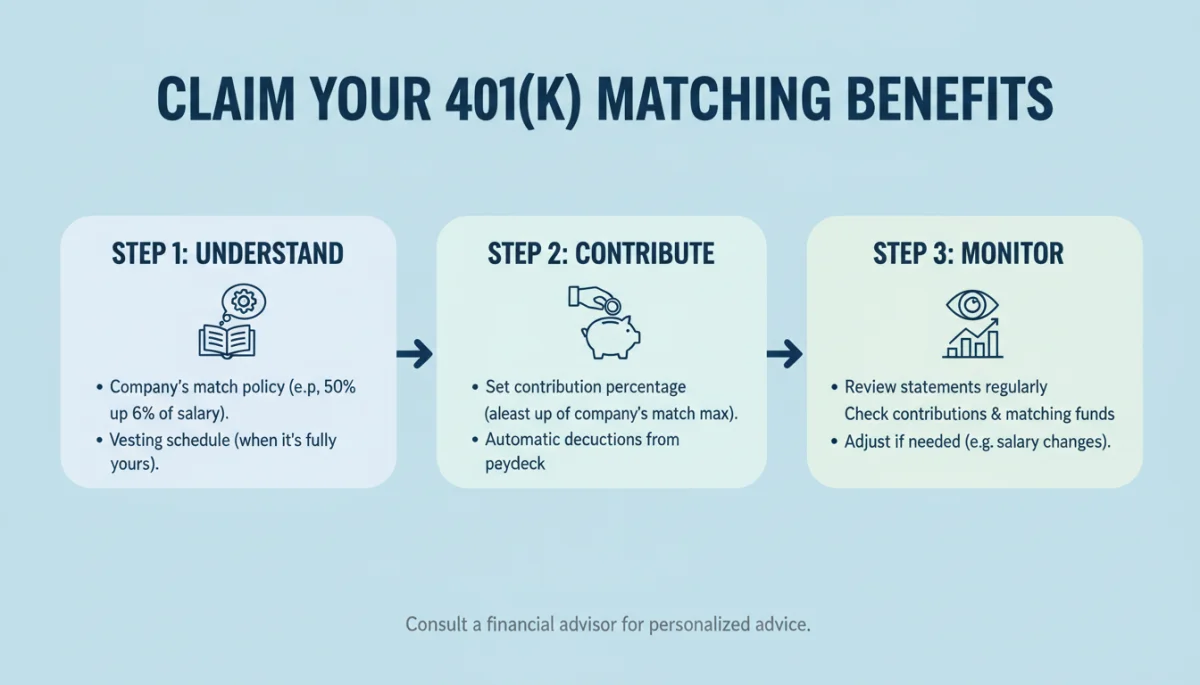
| Key Step | Brief Description |
|---|---|
| Discover Match Policy | Understand your employer’s specific 401(k) matching formula and vesting schedule. |
| Optimize Contributions | Adjust your contribution rate to meet or exceed the maximum employer match percentage. |
| Monitor Regularly | Periodically check for employer contributions and review your investment performance. |
| Avoid Pitfalls | Be aware of common mistakes like under-contributing or ignoring vesting schedules. |
Frequently Asked Questions About 401(k) Matching
The average 401(k) employer match typically ranges from 3% to 6% of an employee’s salary, with common formulas being 50 cents on the dollar up to 6% of pay, or a dollar-for-dollar match up to 3%. However, this can vary significantly by company and industry, so checking your specific plan is crucial.
Even if you can’t afford the full match immediately, contribute as much as possible, starting with at least a small percentage. Gradually increase your contribution by 1% or 2% each year, especially after raises, until you reach the optimal level. Any matched contribution is better than none at all.
It’s advisable to check your 401(k) account at least quarterly, or monthly if you prefer. This allows you to verify employer contributions, review investment performance, and ensure your allocation still aligns with your financial goals and risk tolerance. Regular monitoring helps catch any discrepancies early.
Yes, an employer match is often referred to as ‘free money’ because it’s an additional contribution from your company that you receive simply by participating in your 401(k) plan and meeting certain contribution requirements. It’s a direct boost to your retirement savings that you don’t have to earn through other means.
Yes, you can lose your employer’s 401(k) match if you leave the company before you are fully vested according to the plan’s vesting schedule. Understanding your vesting period (cliff or graded) is crucial to avoid forfeiting these valuable contributions if you change jobs.
Conclusion
Unlocking Your 401(k) Matching Benefits: A 3-Step Guide to Claiming Up to an Extra $5,000 Annually is more than just a financial strategy; it’s a fundamental pillar of smart retirement planning. By diligently following the steps outlined—discovering your company’s policy, optimizing your contributions, and regularly monitoring your account—you position yourself to capture every dollar of employer-matched funds. This seemingly small effort translates into significant long-term wealth accumulation, powered by the magic of compounding. Don’t leave free money on the table; take proactive control of your financial future and maximize these invaluable benefits today.
